What should a bakery do when a customer asks for a tiered cake to be delivered across town?
Delivering a tiered cake is a paid service with real risk, not a courtesy. Here is how to decide when to offer it, what to charge for, and what the order form needs to capture.
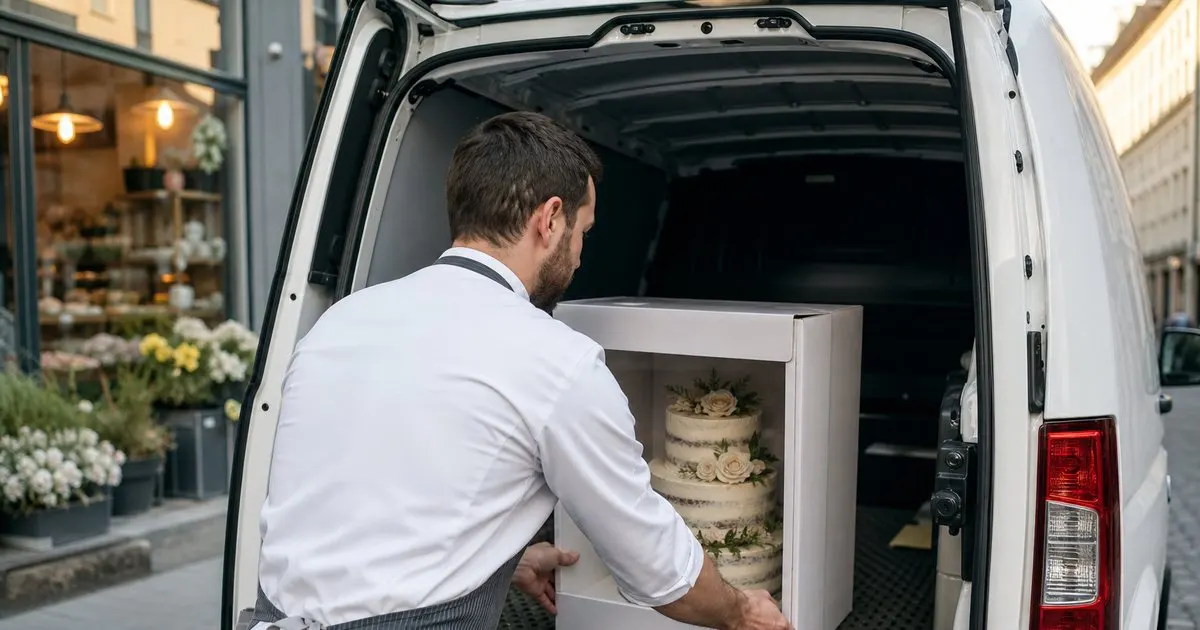
Decide what you deliver and what you let customers carry
A single-tier cake in a sturdy box travels fine in most cars, and most bakeries are comfortable letting customers pick those up. Tiered cakes are different. Once you reach three tiers, or add fresh flowers, sugar work, or a heavy topper, the safest option is usually for the baker to deliver and set up, because you control the stacking, the internal supports, and the final placement. Many bakers transport the tiers separately and assemble on site for exactly this reason. Related: What is the best way for a bakery to quote custom cake orders quickly so customers do not go elsewhere?
Set a delivery radius and a minimum order size for delivery, and decide what happens beyond the radius: a higher zone fee, a referral to a closer bakery, or a polite no. The order form should collect the venue name and address, the event start time, the earliest time you can access the space, and the name and phone number of someone who will actually be there when you arrive. Related: How can a bakery collect all the custom cake order details it needs without endless back and forth?
Keep reading: How can a bakery collect all the custom cake order details it needs without endless back and forth?, How can a cake artist make sure allergen information is never missed on a custom order form?, What is the best way for a bakery to quote custom cake orders quickly so customers do not go elsewhere?. See how CakeIntakr helps you custom cake and bakery order intake forms.
Price delivery as time and risk, not just mileage
Delivery is not a drive. It is packing, loading, driving both ways, carrying, assembling, adjusting, waiting for a venue coordinator, and the fact that you are out of the kitchen for a chunk of a busy day. A flat fee by zone is the simplest way to charge for it, with a separate setup fee for tiered assembly on site and for placing fresh flowers. Keep the fee visible on the form so it never appears as a surprise in the quote. Related: How can a cake artist make sure allergen information is never missed on a custom order form?
Ask about the venue conditions, because they change the risk. Stairs with no elevator, an outdoor reception in summer, a tent without air conditioning, or a cake table that wobbles all matter. Two questions on the form do most of the work: is the cake table indoors and climate controlled, and how long will the cake sit out before it is cut? Buttercream in a hot tent for four hours is a known problem, and knowing early lets you steer the design or plan a later delivery slot.
Capture the delivery details on the form, not in a text the night before
The fields that matter: venue name and full address, on-site contact name and phone, delivery window, exact table location inside the venue, whether a cake stand is provided and its size, who is cutting the cake, and whether you need your stand or boards returned. For weddings, add the planner or coordinator's contact, since they are usually the person who answers the phone on the day.
Require the delivery details to be finalized by the balance due date, and state that changes after that point, such as a new venue or a shifted time, may carry a fee. Show the delivery section only when delivery is selected so the form stays short for pickup customers. Conditional sections like this are a small thing that makes a big difference to completion rates, and it is one of the reasons we designed CakeIntakr around them.
Handoff, responsibility, and the customer who insists on pickup
When you deliver, photograph the cake set up in place and have the on-site contact confirm it looks right. Write into your policy that once the cake is placed, responsibility transfers to the venue or the customer. For customers who want to pick up a tiered cake anyway, educate them: flat surface, air conditioning on, never on a seat, drive slowly, and no sharp turns. Have them sign a pickup acknowledgment, and consider offering the tiers boxed separately with simple stacking instructions if you trust the design to survive it.
It is fine to say plainly that cakes of three tiers or more are delivery only. It is a common professional policy, and most customers respect it once they understand the reason. If a customer still chooses pickup after that conversation, note it on the order and in the confirmation that transport damage after handoff is not covered. That sentence protects you and, honestly, tends to make people reconsider and choose delivery. Related: How can a home baker manage a cake order calendar so two big cakes do not land on the same day?
- Deliver and assemble tiered cakes yourself, and set a radius and minimum for delivery.
- Charge a zone-based flat fee plus a setup fee, and show both on the form.
- Collect venue address, on-site contact, access window, table conditions, and stand details before the balance is due.
- Photograph the set cake, get an acknowledgment, and state when responsibility transfers.

Julien Jimenez
Julien Jimenez is an independent software builder based in Paris. He designs, ships, and operates focused SaaS products for small businesses and independent professionals. Read the full author page.
Cake orders without the mix-ups
Custom cake and bakery order intake forms. CakeIntakr is built to help you put this into practice.
Build your intake formMore from the CakeIntakr blog
Get the CakeIntakr playbook
Practical guides on bakery operations, straight to your inbox as we publish them. No spam, unsubscribe any time.