How do you help customers choose the right cake size on an order form without a phone call?
Most customers have no idea how many people a six-inch cake serves. Here is how to build size guidance into the form so they pick correctly the first time.
Why the guest count alone leads customers astray
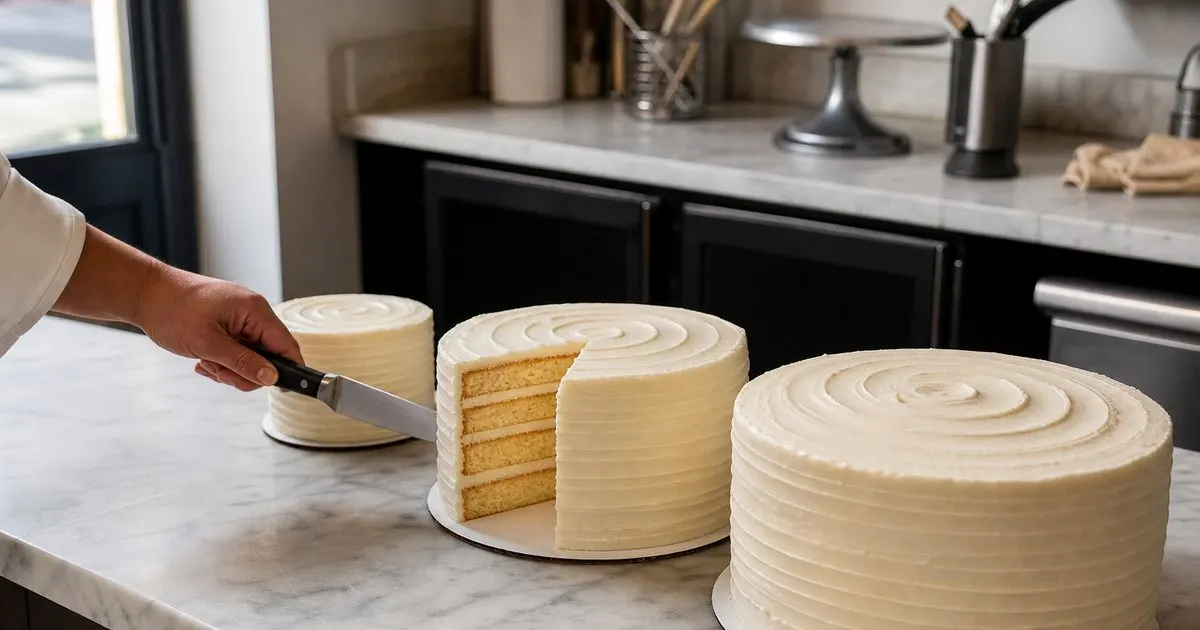
Customers tend to guess a cake size from how it looks in photos, which means they routinely order a six-inch cake for thirty people or a twelve-inch for eight. The trouble is that serves twenty means nothing without a slice size. A slim coffee-style slice, the kind used at weddings where cake is one of several desserts, yields far more portions than a generous party slice for a child's birthday. The same cake can honestly be described as serving two quite different numbers. Related: How can a bakery collect all the custom cake order details it needs without endless back and forth?
So the form needs context before it can help. Ask how many guests are expected, what kind of event it is, whether the cake is the only dessert or one of several, and whether the customer wants leftovers. With those four answers, the form can recommend a size rather than presenting a bare list of diameters and leaving the customer to gamble. Related: How can a cake artist make sure allergen information is never missed on a custom order form?
Keep reading: How can a bakery collect all the custom cake order details it needs without endless back and forth?, How can a cake artist make sure allergen information is never missed on a custom order form?, What is the best way for a bakery to quote custom cake orders quickly so customers do not go elsewhere?. See how CakeIntakr helps you custom cake and bakery order intake forms.
Label every option with servings, and show a photo for scale
Replace a label like eight-inch round with eight-inch round plus your serving count for a party slice, and state the slice size you assume. Different bakeries cut differently, so borrowed serving charts from the internet will not match your cakes. Next to each size, add a photo taken with a familiar object or a hand for scale. A customer who sees that a six-inch cake is about the width of an outstretched hand understands it instantly, where a diagram of concentric circles rarely lands.
For tiered cakes, explain that a two-tier with the same total servings as a large single tier costs more, because of the structure, the extra decorating surface, and the assembly time. Anchor the choice on how many it feeds, then let style options follow. For big events, offer a display cake plus a kitchen cake, meaning a plain sheet cake in the same flavor that stays in the back and is cut for guests. It keeps the display cake elegant and the budget sane. Related: How can a home baker manage a cake order calendar so two big cakes do not land on the same day?
Let the form do the arithmetic with a simple rule
The recommendation logic does not need to be clever. Take the guest count, reduce it a little when other desserts are served, and round up to the nearest size in your lineup. Present the result as guidance, not as a lock: based on thirty-five guests with other desserts, a nine-inch round or a six-and-eight two-tier would work well. If your form tool cannot compute, a short table with three columns (guests, party slices, coffee slices) still moves most customers to a sensible choice.
Ask about height as well. Tall cakes with four or more layers serve more per diameter and cost more, and customers who follow bakers on social media often expect that look without knowing it is a choice. State your standard height in the form, and offer tall as an option with its serving count and price difference shown.
Handle the edge cases before they turn into complaints
A few situations trip people up repeatedly. Cupcakes are often simpler for large casual groups than a huge cake. Sheet cakes serve more per dollar than rounds and suit office parties. Sculpted or carved cakes lose servings to trimming, so the serving count should already reflect that. Dietary variants such as gluten-free or vegan may only be available in certain sizes because of how the batter behaves, and the form should hide or explain unavailable combinations rather than accept them.
Finally, confirm the chosen size and the serving assumption back to the customer in the quote and again in the confirmation. If someone lists thirty guests and picks a six-inch cake, the form should flag the mismatch before they submit, and you should mention it once more when you quote. A single sentence noting that the chosen size gives about a dozen party slices while the guest list says thirty, with an offer to size up, prevents the saddest kind of pickup day conversation. Related: What is the best way for a bakery to quote custom cake orders quickly so customers do not go elsewhere?
- Ask about guests, event type, other desserts, and leftovers before showing sizes.
- Put your own serving counts and the slice size you assume directly in each option label.
- Use scale photos and a kitchen cake option to make tiered and large orders easy to understand.
- Flag mismatches between guest count and chosen size before the form is submitted and again in the quote.

Julien Jimenez
Julien Jimenez is an independent software builder based in Paris. He designs, ships, and operates focused SaaS products for small businesses and independent professionals. Read the full author page.
Cake orders without the mix-ups
Custom cake and bakery order intake forms. CakeIntakr is built to help you put this into practice.
Build your intake formMore from the CakeIntakr blog
Get the CakeIntakr playbook
Practical guides on bakery operations, straight to your inbox as we publish them. No spam, unsubscribe any time.